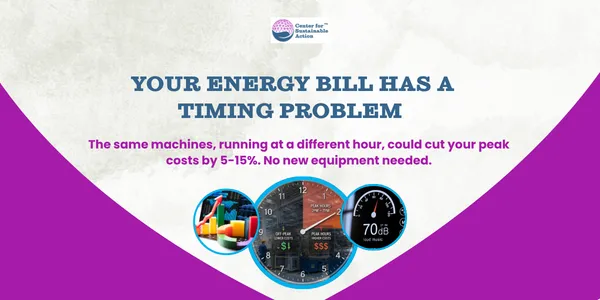
Cut Your Energy Bill by Up to 5–15% by Changing When Equipment Runs — Without Buying New Equipment
A practical guide for SME manufacturers who want fast, measurable savings starting this week.
Could Up to 15% of Your Energy Bill Be Lost to Timing?
What if 5% to 15% of your total energy bill was being wasted every single month — not because your equipment is broken or inefficient, but simply because of when it runs?
Across small and mid-sized manufacturing facilities, business owners and plant directors are often paying premium electricity rates during peak hours without realising it.
The compressors are humming.
The production line looks optimal.
And the meter may be recording units at the most expensive rate of the day.
The good news? You do not need a six-figure capital investment, new machinery, or plant downtime to fix it. You need an operational schedule grounded in structured energy management.
Default Operational Schedules Are Squeezing Margins
You are running a tight manufacturing operation. Margins are squeezed, raw material costs are volatile, and energy bills have become one of those unpredictable line items in the budget that nobody quite knows how to control.
Here is what is often happening on your factory floor right now:
Simultaneous morning power-ups: Heavy equipment — compressed air systems, industrial refrigeration, thermal HVAC and large electric motors — powers up all at once first thing in the morning.
Unmanaged peak-load running: Heavy equipment runs at full load into the late afternoon and early evening, right when grid demand and unit prices peak.
Unmapped tariff gaps: Nobody on the floor has mapped exact energy consumption patterns against your energy supplier's hourly tariff rates.
You aren't being reckless — you are simply running the business the way it has always been run. But that default operational pattern could be quietly eroding your margin every month.
Why It Matters: Time-of-Use (ToU) Tariffs and Grid Demand
Under Time-of-Use (ToU) and half-hourly metered tariffs — common on larger UK business supplies — electricity used during peak weekday hours (often around 4:00 PM to 7:00 PM, depending on your region and contract) can cost significantly more per kilowatt-hour (kWh) than the exact same energy used off-peak or overnight.
When you run heavy equipment through these peak windows, you can pay a significant premium, largely from network "red band" charges that suppliers pass through. If you aren't actively managing when your equipment runs, you are essentially letting your energy supplier dictate your profit margin.
The energy timing misalignment
Time (weekdays) | Typical rate | Best use |
|---|---|---|
Morning | Standard day rate | Production and pre-charging |
Early afternoon | Standard day rate | Finish pre-cooling and energy-heavy batches |
4:00 PM – 7:00 PM | Peak (highest unit rates) | Essential production only — shift flexible loads out |
Evenings, nights and weekends | Off-peak | Maintenance, battery charging, air storage top-ups |
From One-Off Hacks to Governed Energy Systems (SDG 7)
Energy efficiency isn't just about turning off lights; it is an operational capability. Frameworks such as ISO 53001 (with its implementation guidance, ISO 53002) and SDG 7 (Affordable and Clean Energy) encourage SMEs to treat energy reduction as an ongoing, governed management habit rather than an isolated administrative project.
5 Practical Steps to Cut Peak-Hour Energy Costs
Step 1: Understand Your Tariff — Know When You're Being Charged Most
Before changing operational schedules, get complete visibility into your current energy contract and tariff structure.
Query your broker or supplier: Ask: "Do we operate on a Time-of-Use (ToU) or half-hourly metered tariff?"
Request half-hourly consumption data: Many UK business meters (half-hourly and smart meters) already record half-hourly data. Request your last 12 months of consumption data in CSV format.
Identify peak charging windows: Pinpoint your supplier's highest rate windows (often weekday late afternoons, around 4:00 PM to 7:00 PM; exact times vary by region).
Once you establish exactly when your electricity costs the most, you can begin shifting flexible operational loads away from those high-cost windows.
Step 2: Audit Your Equipment — Identify Flexible Loads
Not every machine on a factory floor can be rescheduled. However, more equipment is often flexible than plant managers first assume.
Walk the factory floor asking one core question: "Does this machine need to run at this exact minute, or does its output just need to be completed today?"
Must run (rigid production) | Can shift (flexible energy loads) |
|---|---|
Active assembly lines | Compressed air tank charging |
Time-critical client orders | Refrigeration & cold-store pre-cooling (within safe product temperature limits) |
Safety-critical extraction | Thermal HVAC pre-heating/cooling |
Continuous thermal processes | Forklift & fleet EV charging (in designated, ventilated charging areas) |
Batch cleaning & maintenance (with safe staffing and supervision) |
High-impact focus: Compressed air systems and thermal HVAC are often strong candidates for load shifting, because both can store energy (as pressure or temperature) ahead of peak tariff periods.
Step 3: Build a Governed Equipment Schedule
Building a load-shifting schedule does not require complex or expensive enterprise software. A structured, three-phase daily schedule can start reducing costs from your next billing period.
1. Pre-peak window (before 4:00 PM)
Run high-draw equipment (compressors, large electric motors, heavy HVAC) at the capacity you need, within manufacturer operating limits.
Pre-charge compressed air receivers (never above their rated safe operating pressure), pre-cool cold storage units (keeping product within its required temperature range), and complete energy-intensive batch processing.
2. Peak window (4:00 PM – 7:00 PM weekdays)
Restrict operation strictly to active, essential production lines.
Idle, power down or step down non-critical ancillary systems — never safety-critical systems such as extraction, ventilation, fire or emergency systems.
Where possible, avoid starting large electric motors during peak hours to reduce peak-period consumption and any demand-related charges on your contract.
3. Off-peak window (evenings, early mornings, weekends)
Schedule heavy maintenance cycles, line washdowns and tool cleaning, with appropriate staffing, supervision and lone-working controls.
Use basic automated timers or smart controls to delay battery charging (forklifts, floor scrubbers) until off-peak hours, following the charger manufacturer's guidance and your fire risk assessment.
Where storage needs topping up, schedule compressors to run off-peak, and fix air leaks, which waste energy around the clock.
Step 4: Deploy Low-Cost Digital Monitoring
You cannot manage what you do not measure. Establishing accurate operational baselines helps stop single-machine energy spikes from eroding monthly margins, moving energy management from an unmonitored expense into a governed operational process.
Core components of digital energy monitoring
Targeted circuit sub-metering: Have a qualified electrician fit cost-effective (often clip-on) sub-meters on key energy-consuming circuits to track individual machine performance and isolate operational waste, with minimal disruption to existing wiring.
Digital dashboard integration: Connect energy sensors to digital monitoring dashboards to record real-time electricity consumption and provide continuous visibility over peak demand patterns.
Automated digital data workflows: Bring consumption data into a digital management platform (such as SDG Assessment Level 1) to build traceable, auditable records that support ISO 53001 and SDG 7 (Affordable and Clean Energy) reporting, reducing the errors and data loss common in manual spreadsheets.
Step 5: Access Funded Support & Build an ISO 53001-Aligned Management Baseline
The most effective manufacturers do not treat energy savings as a one-off project — they embed energy management directly into their operational governance.
Tap into UK support schemes: Depending on where you are, free or part-funded energy audits, local decarbonisation grants and advisory programmes may be available to UK SMEs. Schemes open and close often, so check with your local authority or Growth Hub before planning around one.
Align with SDG 7 (Affordable and Clean Energy): Using ISO 53002 guidance to implement an ISO 53001 management system helps SMEs prioritise SDG 7 and SDG 12 (Responsible Consumption and Production), turning timing adjustments into an ongoing, managed practice.
Generate tender-ready evidence: Capturing well-evidenced energy and carbon data supports the Scope 1 and 2 reporting that larger buyers increasingly ask for in tenders, and which feeds into their own Scope 3 reporting.
Real-World Case Study: Capital Cooling Ltd
Over £50,000 in Annual Savings | 28% Carbon Footprint Reduction
By applying the Centre for Sustainable Action (CSA) methodology and targeting operational inefficiencies across energy schedules and procurement, Scottish refrigeration SME Capital Cooling Ltd achieved over £50,000 in annual cost savings and a 28% reduction in its carbon footprint through data-driven operational changes rather than heavy capital expenditure. Results vary by site; this is a documented example, not a guaranteed outcome.
Summary Checklist for Plant Managers
Identify your tariff peak window (often around 4 PM–7 PM; check your contract).
Categorise equipment into rigid vs. flexible energy loads.
Establish a pre-cool/pre-charge schedule before your peak window starts, within safe operating limits.
Have a qualified electrician install clip-on sub-meters on your top 3 energy-consuming assets.
Embed energy tracking into an ISO 53001 management system (using ISO 53002 guidance) to build tender-ready evidence and strengthen grant applications.
Savings figures in this guide are indicative and depend on your tariff, equipment and operations. Always follow manufacturer guidance and your own risk assessments before changing equipment schedules.
If our practical tips have made your path brighter or your goals feel more achievable, your words could light the way for others. Please share your experience in a Google review today. Click here!
Disclaimer
The information provided in this guide is for general informational purposes only and is not intended as professional advice. While every effort has been made to ensure the accuracy and reliability of the information, The Center for Sustainable Action (CSA) assumes no responsibility for errors, omissions, or any outcomes resulting from the use of this material. Users are encouraged to seek professional advice tailored to their specific needs before making decisions based on the content of this guide. CSA shall not be held liable for any damages or losses arising from reliance on this guide.
Copyright Protection Statement
© 2025 The Center for Sustainable Action (CSA). All rights reserved. This guide, including all content, graphics, and design, is protected by copyright law. Unauthorised reproduction, distribution, or modification of this material, in whole or in part, is strictly prohibited without prior written consent from CSA. For permission requests, please [email protected].


