Sustainable Development as a Business Performance System
A Strategic Guide to ISO 53001 and ISO 53002 for Construction & Manufacturing Leaders
Sustainable development is not a compliance burdenit's a proven management system that improves operational efficiency, controls costs, stabilizes your workforce, and wins more tenders. ISO 53001 and ISO 53002 provide the framework to make this happen.
ISO 53001 is the certifiable management system standard that integrates UN Sustainable Development Goals (SDGs) into your strategy, governance, and daily operations. ISO 53002 is the practical guidance document that shows you how to implement ISO 53001 effectively across all operational aspects.
For construction and manufacturing companies with 70–150 employees, these standards deliver measurable business outcomes: 3–5.5% improvements in production efficiency, 4–7% reductions in energy consumption per unit, and stronger technical scores in tender evaluations. The result is better cost control, reduced risk, and a competitive edge that directly impacts profitability.
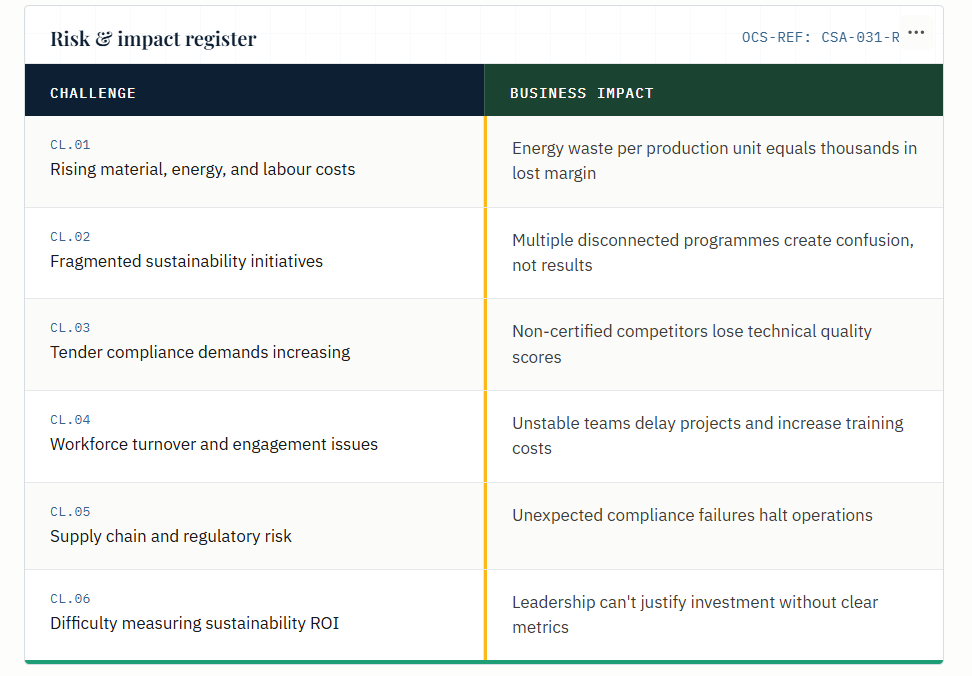
Key Business Challenges We See Daily
Construction and manufacturing leaders face pressure from multiple directions:
Why Current Approaches Are Failing
Most companies try sustainability through:
One-off projects (e.g., installing solar panels without system-wide efficiency improvements)
Voluntary carbon claims without auditable evidence
ISO 14001 alone (environmental only, missing social and economic pillars)
Marketing-focused SDG statements without operational integration
The problem: These approaches are siloed, unmeasurable, and don't embed sustainability into governance or decision-making. They create the appearance of action without the performance improvement.
What ISO 53001/53002 Actually Do (in Business Terms)
ISO 53001: The Management System
ISO 53001 specifies requirements for a Sustainable Development Goals Management System. It's certifiable, meaning you can get third-party validation that your system meets international standards.
What it requires you to do:
Integrate SDGs into strategy and governance (not as an add-on, but as core decision-making)
Identify and manage significant sustainability issues affecting your operations
Embed sustainability into operational planning and daily processes
Provide auditable evidence of sustainability performance for clients, regulators, and investors
Demonstrate compliance obligations and achieve selected SDG objectives
Intended outcomes: Enhanced performance, fulfilled compliance, achieved objectives, increased success, and created stakeholder trust.
ISO 53002: The Implementation Guide
ISO 53002 is the accompanying guidance document developed with UNDP. It's not certifiable, but it's essential for implementing ISO 53001 effectively.
What it provides:
Holistic framework addressing all 17 SDGs (avoiding siloed approaches)
Action-oriented guidance on identifying, prioritizing, and managing stakeholder impacts
Measurable outcomes with clear objectives and progress tracking
Risk management methods to mitigate negative impacts and avoid costly consequences
Innovation and efficiency drivers by encouraging operational improvements
Continuous improvement culture for ongoing performance enhancement
Strategic Benefits for Construction & Manufacturing
1. Operational Efficiency
Energy reduction
Production efficiency - process and product improvements
Resource optimization: Reduced waste and material consumption directly improve bottom line
2. Cost Control
Direct savings: 28% reduction in organisational carbon footprint
Process optimization: ISO management systems positively impact return on assets (ROA)
Waste reduction: Every ton of waste avoided = material cost saved + disposal cost avoided
3. Workforce Stability & Engagement
SDG 8 (Decent Work): Framework ensures decent work conditions, reducing turnover
Stakeholder engagement: Worker involvement in sustainability fosters buy-in and trust
Safety integration: Aligns with ISO 45001 principles for occupational health and safety
4. Risk Management
Proactive identification: Anticipate sustainability-related risks before they become costly
Compliance obligations: Systematic approach ensures you meet regulatory requirements
Supply chain resilience: Better stakeholder management reduces disruption risk
5. Business Resilience
Long-term perspective: Consider implications for future generations, ensuring sustained operations
Continuous improvement: Culture of ongoing enhancement adapts to evolving challenges
Global alignment: Benchmark against international best practices
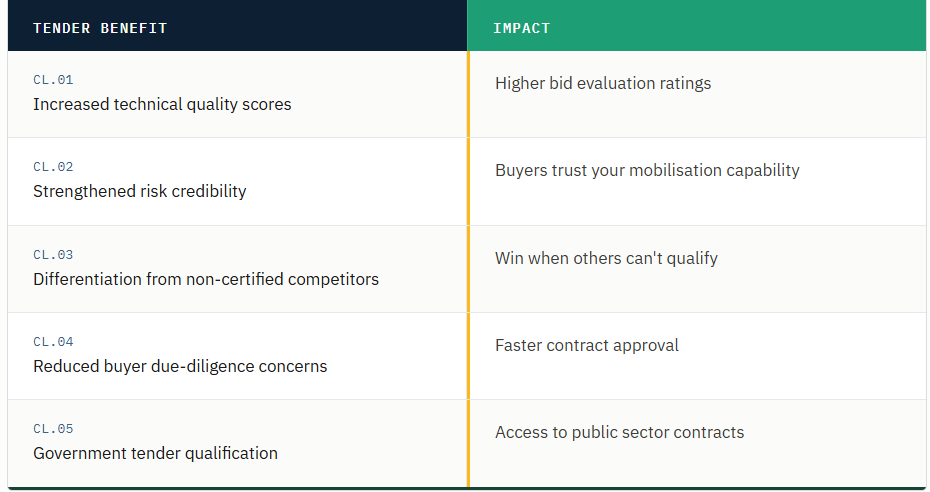
6. Competitive Advantage in Tenders
What does it looks like in real business
Construction: Concrete Manufacturing Efficiency
A concrete product manufacturer implemented an efficiency improvement project aligned with SDG management principles:
5.5% production efficiency improvement
£1.5 million annual revenue reduction in lost revenue
Direct cost savings from reduced material waste and energy consumption
Manufacturing: Textile Energy Performance
A Sri Lankan textile manufacturer implemented energy management system standards:
Energy performance improved from 135.03MJ/kg to 128.72MJ/kg (4.67% reduction)
Annual cost saving: $34,522
Measured per dyed kilogram of fabric
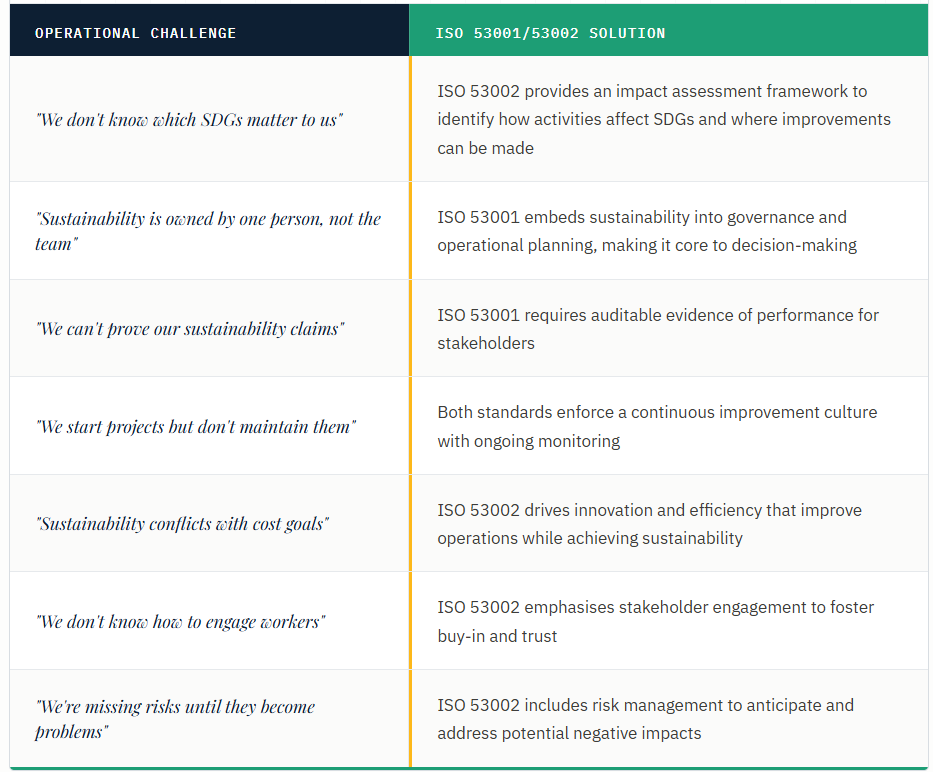
Common Operational Challenges & How ISO Frameworks Solve Them
Implementation Roadmap (High-Level)
Phase 1: Strategic Foundation (Months 1–3)
Quick Wins:
Conduct SDG Assessment Level 1 analysis to identify which SDGs matter most to your business
Map current activities against SDGs to find immediate improvement opportunities
Align leadership team on 2–3 priority SDGs tied to business outcomes
Leadership Action:
Define sustainability policy that integrates with business strategy
Assign accountability (not just "sustainability person"embed in operations)
Phase 2: System Design (Months 4–6)
Quick Wins:
Integrate ISO 53002 guidelines into existing management systems (quality, environmental)
Identify 3–5 measurable objectives with clear tracking (e.g., energy per unit, waste reduction)
Launch one stakeholder engagement process (e.g., worker sustainability committee)
Leadership Action:
Embed sustainability into operational planning processes
Allocate resources for implementation (time, budget, training)
Phase 3: Implementation & Monitoring (Months 7–12)
Quick Wins:
Implement one efficiency improvement project (energy, material, or process)
Begin tracking progress against objectives with monthly reporting using SPF+UN SDPI Scorecard.
Document compliance obligations and create compliance checklist
Leadership Action:
Review performance data quarterly and adjust strategy
Communicate progress to stakeholders (workers, clients, investors)
Phase 4: Certification & Optimization (Months 13–18)
Long-Term Strategy:
Prepare for ISO 53001 third-party certification audit
Conduct internal audit to identify gaps before certification
Expand SDG integration across all operational aspects
Leadership Action:
Use certification for tender advantage and client trust
Embed continuous improvement into annual business planning
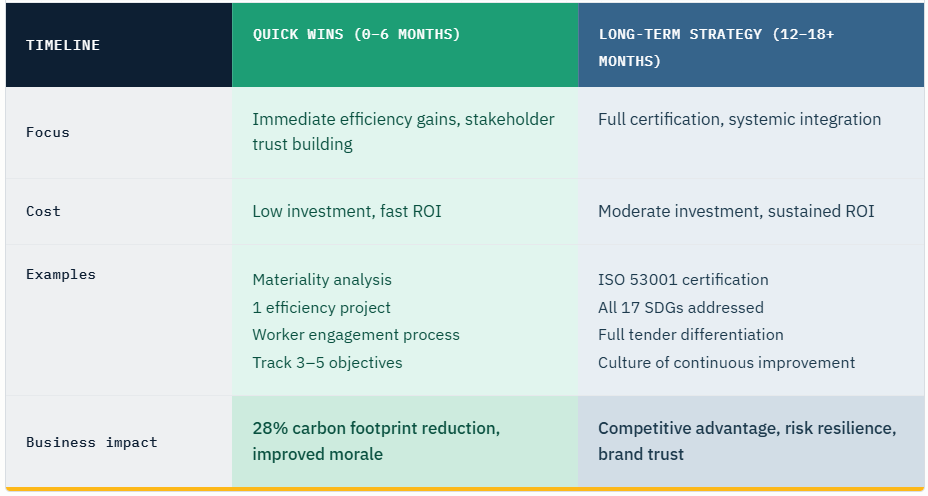
Quick Wins vs. Long-Term Strategy
Leadership Actions Required
What Senior Decision-Makers Must Do:
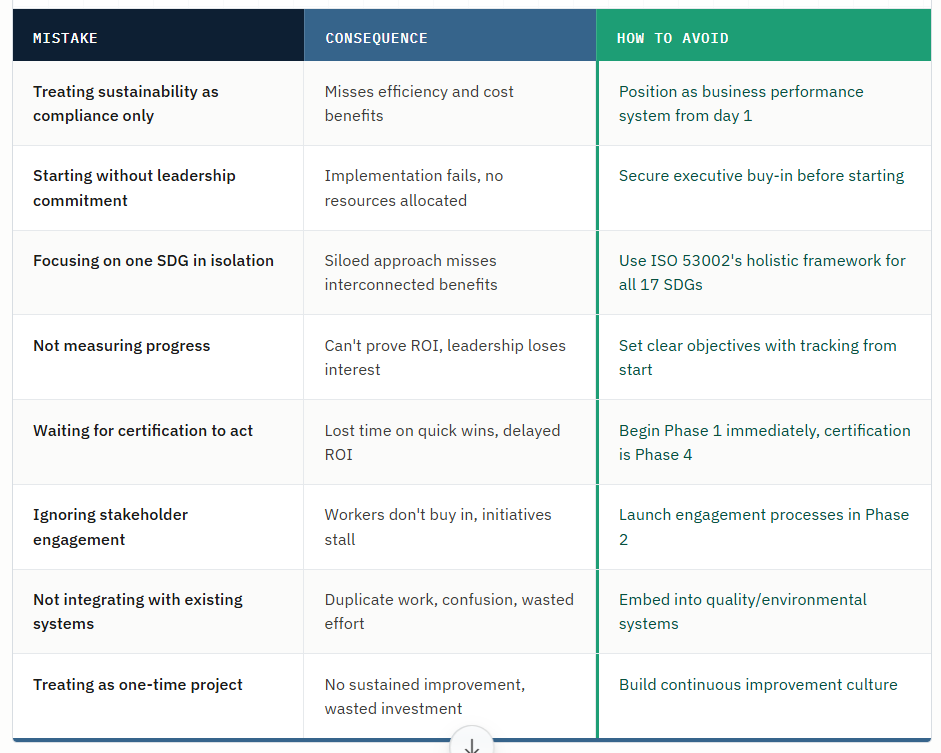
Treat sustainability as a business performance system, not a compliance project
Integrate SDGs into strategy and governance make it core to decision-making
Allocate resources (time, budget, people) for implementation
Embed sustainability into operational planning, not as an add-on
Review performance data quarterly and adjust strategy
Communicate progress to stakeholders to build trust
Use certification for competitive advantage in tenders
Support continuous improvement culturethis is ongoing, not one-time
What NOT to Do:
Don't treat this as a "sustainability person's project"it's leadership's responsibility
Don't wait for full certification to start/begin with quick wins immediately
Don't silo SDGs address all 17 interconnected goals holistically
Common Mistakes to Avoid
Final Strategic Summary
ISO 53001 and ISO 53002 are not about "being green"they're about running a better business.
The business case is clear:
28% carbon footprint reduction = direct cost savings
Production efficiency improvement
Higher tender scores = competitive advantage and win rate improvement
Auditable performance evidence = increased client trust and faster contract approval
Continuous improvement culture = long-term resilience and adaptability
The implementation path is structured:
Start with quick wins in 3–6 months (materiality analysis, 1 efficiency project, stakeholder engagement)
Build system over 12–18 months (full integration, certification)
Achieve sustained ROI through continuous improvement
The leadership requirement is clear:
This is not a "sustainability person's project"it's executive-level strategic work
Integration into governance and operational planning is non-negotiable
Resource allocation and quarterly performance review are essential
For construction and manufacturing companies with 70–150 employees, ISO 53001/53002 provides the framework to turn sustainable development from a fragmented burden into a commercially valuable business performance system.
Explore How ISO 53001/53002 Could Apply to Your Business
If you're ready to see how these standards could improve operational efficiency, control costs, and strengthen your tender position, book a consultation with our team. We'll analyze your current operations, identify priority SDGs tied to your business outcomes, and outline a practical implementation path with quick wins you can start within 3 months.
Let's explore how ISO 53001/53002 can become a competitive advantage for your business.
If our practical tips have made your path brighter or your goals feel more achievable, your words could light the way for others. Please share your experience in a Google review today. Click here!
Disclaimer
The information provided in this guide is for general informational purposes only and is not intended as professional advice. While every effort has been made to ensure the accuracy and reliability of the information, The Center for Sustainable Action (CSA) assumes no responsibility for errors, omissions, or any outcomes resulting from the use of this material. Users are encouraged to seek professional advice tailored to their specific needs before making decisions based on the content of this guide. CSA shall not be held liable for any damages or losses arising from reliance on this guide.
Copyright Protection Statement
© 2025 The Center for Sustainable Action (CSA). All rights reserved. This guide, including all content, graphics, and design, is protected by copyright law. Unauthorised reproduction, distribution, or modification of this material, in whole or in part, is strictly prohibited without prior written consent from CSA. For permission requests, please contact[email protected].


